Smart lighting can improve comfort, reduce unnecessary energy use, and make hotel operations more responsive. But retrofitting an occupied property is different from designing a new building. Existing wiring, room layouts, operating schedules, and guest expectations all shape what will work. A bedside switch may control several fixtures, while a corridor needs steady illumination throughout the night. Small details matter.
So, how to integrate smart lighting controls into an existing hotel? Start with a site assessment, not a product catalog. Review representative guest rooms, meeting spaces, service areas, and corridors. Document fixture types, control circuits, network coverage, and maintenance concerns. Then select a limited pilot area and test dimming quality, switch placement, response time, and staff workflows. A control that looks impressive on a screen can still frustrate a guest if the room takes several taps to become comfortable.
Compatibility deserves careful attention. Some older lamps or drivers may flicker when paired with incompatible dimmers, and wireless signals can weaken behind dense walls. Work with qualified lighting and controls professionals to verify equipment, establish appropriate settings, and plan safe installation around hotel operations. Keep manual controls clear. Train engineering and front-desk teams before expanding the system.
The first plan may be wrong. A pilot may reveal confusing scenes, unexpected maintenance needs, or rooms that behave differently. Treat that feedback as useful evidence, revise the design, and track results such as energy use, guest comments, and service calls. A measured retrofit is rarely flashy, but it is more likely to fit the building and the people who use it.
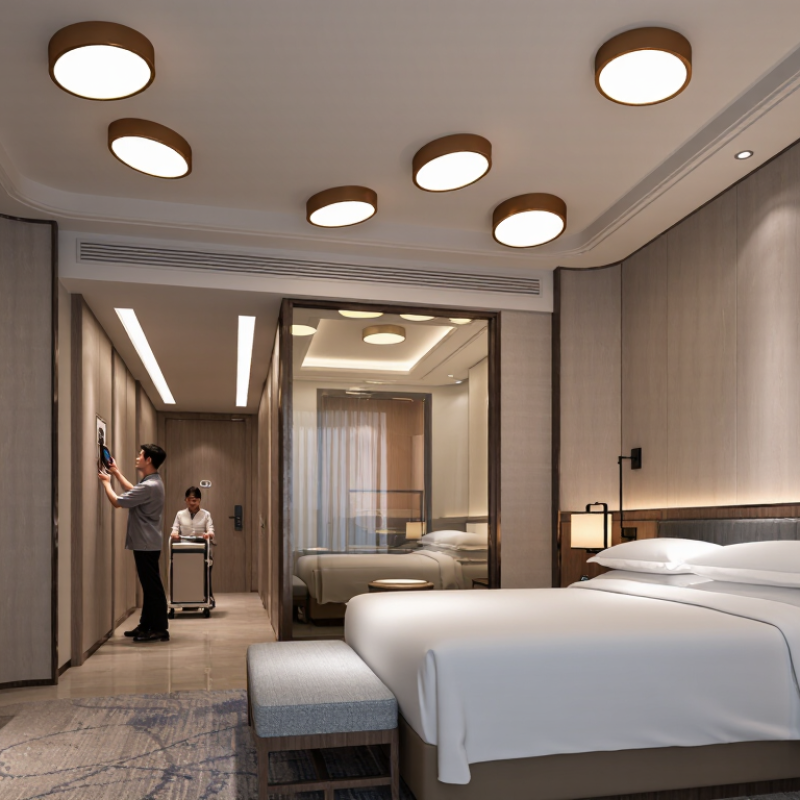
Assess Existing Hotel Lighting with DOE Benchmarks and Room-by-Room Audits
Before selecting smart controls, establish a baseline. The U.S. Department of Energy’s Commercial Buildings Energy Consumption Survey (CBECS) provides lodging-sector energy data, including differences by building size and climate. Compare your hotel with similar properties, then review whole-building energy use alongside lighting schedules and utility bills. A benchmark is a starting point, not a diagnosis.
Walk every room type, corridor, meeting space, and back-of-house area. Record fixture types, switching zones, daylight, occupancy patterns, and late-night cleaning routines. Note where guests need simple, familiar controls; a sensor that dims a reading lamp during quiet use may frustrate more than help. Lawrence Berkeley National Laboratory’s review found average occupancy-sensor lighting savings of 24% across studied spaces. That figure is not a hotel-specific promise. Audits can miss habits, too; verify findings with staff and short-term measurements before choosing controls.
Tips: Photograph existing switches and label circuits during the audit. Test one representative room, including bedside lamps and bathroom lighting, before expanding. Keep the exceptions. A little untidy data is better than a confident guess.
Prioritize LED Retrofits: DOE Finds LEDs Use at Least 75% Less Energy
In an existing hotel, smart lighting upgrades work best when the lamps and controls are considered together. The U.S. Department of Energy reports that LEDs use at least 75% less energy than incandescent lighting and can last up to 25 times longer. These figures are a useful benchmark, not a guaranteed hotel-wide saving: results depend on the old lamps, operating hours, and control settings. Start with a room-by-room lighting audit. Note lamp types, fixture compatibility, and where daylight reaches desks or corridors. A warm, even light matters; guests notice harsh glare on a bedside wall.
Tips: Pilot one guest room and one corridor. Pair compatible LED lamps with occupancy sensors and dimming controls, then check for flicker, delayed response, and confusing switches. Ask housekeeping and maintenance staff to test the settings during real shifts. Small details count.
For existing hotels, phased retrofits can limit disruption and reveal problems before wider installation. Use occupancy controls in meeting rooms and back-of-house areas, and daylight dimming near large windows. Set guest-room controls to preserve a simple manual option; overly complex automation can frustrate tired travelers. Record energy use before and after the pilot, while keeping schedules and occupancy in mind. The retrofit is not always tidy: older wiring or mixed fixtures may require adjustments. That uncertainty deserves a budget line, not an optimistic guess. DOE guidance supports the efficiency case for LEDs, but each property should verify compatibility and actual savings through measured results.
Design Zoned Controls with DALI-2, BACnet, and ASHRAE 90.1 Requirements
When upgrading lighting in an existing hotel, divide controls by how spaces are actually used. Guestrooms, corridors, meeting rooms, and service areas need different schedules and responses. DALI-2 can address individual fixtures or groups, making it easier to adjust a guestroom without changing a whole floor. BACnet can connect lighting status and control points to the building management system. Keep the gateway plan clear: a confusing point list can slow down maintenance later. Small details count.
ASHRAE 90.1 requirements depend on the adopted edition and local project conditions, so confirm the applicable provisions before design. They may include occupancy-based control, automatic shutoff, daylight response, and functional testing. Map sensors to real activity, not just convenient ceiling locations. In a corridor, a sensor aimed at a doorway may leave a quiet stretch dim. That matters. During retrofit work, check existing wiring, panel capacity, and device compatibility before ordering equipment. Commission each zone after installation, then test schedules, sensor delays, and manual overrides with hotel staff. A control sequence can look right on paper and still frustrate night staff. Allow time for adjustments.
Install Occupancy and Daylight Sensors: DOE Reports 10–30% Lighting Savings
In existing hotels, occupancy and daylight sensors can reduce wasted lighting without replacing every fixture. The U.S. Department of Energy reports potential lighting savings of 10–30% from these controls. Actual results depend on room use, sensor placement, and operating settings. The range is useful, not a guarantee.
A practical retrofit starts with spaces where lights are often left on: meeting rooms, staff areas, storage rooms, and corridors with predictable traffic. Occupancy sensors should detect people from likely entry points, not just the center of a room. Daylight sensors work best near windows, where they can dim electric lights as natural light increases. Test them at different times of day. A bright afternoon can reveal problems that a morning check misses.
Guest comfort matters as much as energy use. In a guest room, an overly short timeout can leave someone in the dark while reading quietly. Set a reasonable delay and provide a simple manual control. Small details matter. During commissioning, record existing lighting schedules and compare them with sensor operation after installation. One imperfect part: hotel spaces rarely follow identical routines, so a single setting may not suit every floor. Adjustments may be needed after staff and guest feedback.
How to Integrate Smart Lighting Controls in Existing Hotels? — Install Occupancy and Daylight Sensors: DOE Reports 10–30% Lighting Savings
| Hotel Area |
Recommended Control |
Integration Approach |
Commissioning Check |
| Guest rooms |
Occupancy or vacancy sensing |
Use sensors to switch or reduce lighting when rooms are unoccupied. Select settings that avoid unwanted shutoff while guests are resting. |
Test from typical positions, including the bed and bathroom; confirm manual control and appropriate timeout behavior. |
| Corridors and back-of-house areas |
Occupancy sensing with scheduled light levels |
Maintain the required baseline lighting and raise levels when activity is detected, where the existing fixtures and controls support dimming. |
Check sensor coverage, transition smoothness, nighttime operation, and applicable egress-lighting requirements. |
| Lobby and lounge areas near windows |
Daylight-responsive dimming |
Place daylight sensors to measure representative natural light and dim compatible electric lighting as daylight increases. |
Calibrate with electric lights on and off; check for stable dimming and consistent light levels at different times of day. |
| Meeting and event rooms |
Occupancy sensing, daylight response, and scene controls |
Coordinate sensors with room-use schedules and presenter or conference scenes; retain accessible manual overrides. |
Test each scene, sensor zone, override, and return-to-normal behavior after the room is vacated. |
| Whole-property evaluation |
Savings measurement and verification |
Compare lighting energy use before and after installation, accounting for operating hours, occupancy, and changes to the lighting system. |
Use a consistent baseline and review control settings after staff and guest feedback. |
Energy-savings context: The 10–30% figure is a reported potential range for lighting savings, not a guaranteed result for every hotel. Actual savings depend on existing controls, operating schedules, daylight availability, occupancy, commissioning, and occupant behavior.
Commission and Verify Performance Using IPMVP and kWh per Room-Night
Begin with a written measurement and verification plan before changing controls. Record fixture wattages, operating schedules, occupied rooms, and existing control settings. For several weeks, check a sample of guest rooms, corridors, and back-of-house areas. Keep the boundary clear. Small details matter.
Choose an IPMVP approach that matches the project. For a lighting-only retrofit, Option A can use verified equipment specifications and measured operating hours, with key assumptions documented. Option B uses measurements of both power and operating hours, which can better capture changing schedules. If lighting savings are difficult to separate from other building changes, Option C may be considered, but whole-building results can be less specific. State the method, adjustment rules, and any sampling limits in advance.
Track lighting energy as kWh per occupied room-night, not just total monthly kWh. Divide the measured lighting energy by occupied room-nights for the same period, and compare like seasons where possible. Review occupancy data alongside meter readings; an empty room and a late checkout can change the result. The baseline will rarely be perfect. Note gaps, sensor overrides, and schedule changes rather than hiding them. After commissioning, test a room at the switch, at the sensor, and from the central control system. Confirm lights respond as intended, then revisit the metric after staff and guests have used the system.
Conclusion
How to integrate smart lighting controls into an existing hotel? Begin with a room-by-room audit to document fixture types, operating schedules, control systems, and energy use. Compare findings with relevant Department of Energy benchmarks to identify high-consumption areas and opportunities for improvement. Prioritize replacing inefficient fixtures with LEDs, which use at least 75% less energy than traditional lighting, while considering guest comfort, existing wiring, and maintenance needs.
Next, organize lighting into practical zones and select compatible controls, such as systems using DALI-2 or BACnet, while aligning the design with applicable ASHRAE 90.1 requirements. Add occupancy sensors in spaces that are used intermittently and daylight sensors where natural light is available; these measures can reduce lighting energy use by 10–30%. After installation, commission the system, train staff, and verify results using an IPMVP-based approach. Track kWh per room-night and compare performance over time to confirm savings and identify adjustments.

 Trandic Light