Lighting does more than brighten a room. It gives a brand a physical voice. A warm pendant can suggest hospitality, while a sharp linear fixture may express precision. These choices become visible across stores, hotels, offices, and exhibitions. Yet custom lighting is not decoration alone. It involves optics, materials, heat management, maintenance, and consistent color performance. A beautiful prototype can fail when glare tires customers or replacement parts disappear.
How to customize lighting fixtures for a unique brand identity? The answer begins with brand evidence, not a fashionable shape. Designers should study logo geometry, signature colors, customer behavior, ceiling heights, and the emotional pace of each space. A café may need soft pools of light over tables, while a technology showroom may require clean vertical illumination. Mock-ups, photometric tests, and on-site observations help turn ideas into dependable specifications. In my experience, a small sample fixture often reveals more than polished renderings. It exposes shadows, reflections, fingerprints, and awkward installation points.
Reliable customization also requires close cooperation among brand teams, lighting engineers, manufacturers, and installers. Material samples should be checked under actual lamps, not only under studio lighting. Color may shift. Finishes may age. Details matter. Internationally recognized safety and performance standards should guide product selection, with qualified professionals reviewing electrical and fire-related requirements. This process protects identity while supporting comfort, efficiency, and long-term service. Not every design decision will be perfect. A fixture may look distinctive yet feel too cold, or photograph well but waste energy. Thoughtful revision is part of the craft, and this guide explores the decisions that make branded lighting both memorable and responsible.
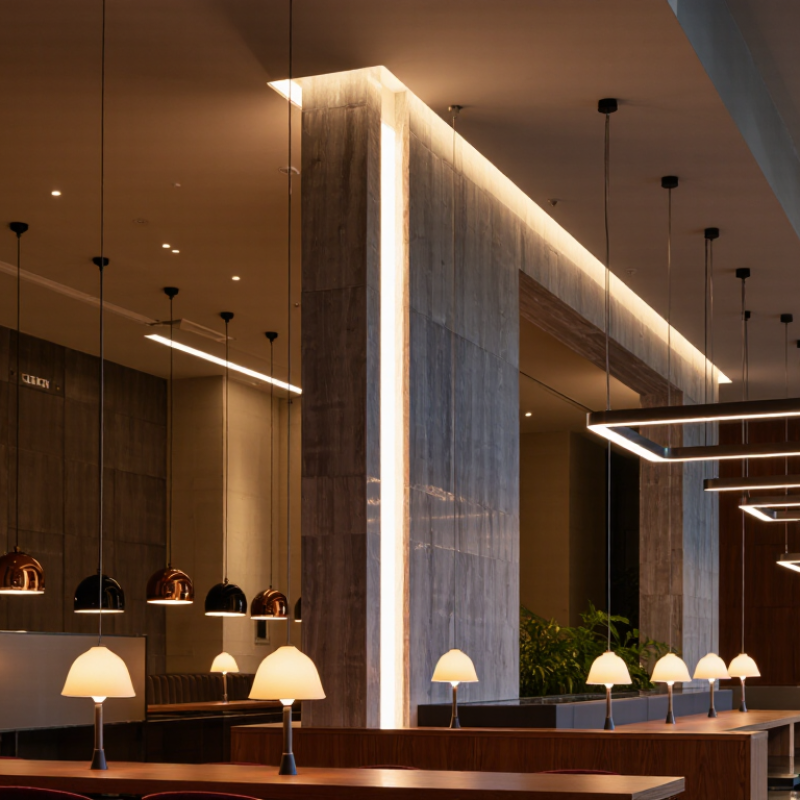
Brand lighting should begin with a measurable goal, not a color preference. The U.S. Department of Energy reports that LED lighting uses at least 75% less energy than traditional incandescent lighting. This difference can shape fixture size, operating costs, and maintenance plans. However, actual savings depend on wattage, daily use, controls, and installation quality.
For a welcoming retail space, warm LEDs around 2700K to 3000K can soften counters and product displays. For a technical showroom, cooler light may support a precise, clean atmosphere. Use matching beam angles across repeated fixtures. Uneven brightness can make a carefully designed space feel accidental.
A simple lighting test helps: place sample fixtures at customer eye level, then inspect shadows, glare, and color accuracy.
Measure before ordering.
Track wattage, operating hours, and estimated annual energy use. Add dimming or occupancy controls where practical. These features can reduce consumption beyond the fixture upgrade, though they require correct commissioning.
Our first mock-up once looked attractive but created glare on polished surfaces. We adjusted the mounting height and diffuser, but the original choice was still a useful warning.
Energy efficiency should not erase comfort. Brand identity becomes stronger when customers notice the environment, not the lighting hardware. LED performance also varies between products, so review independent test data, warranty terms, color consistency, and heat management before approval.
Lighting fixtures can become part of a brand’s visual language. Their housing color, beam shape, and CCT should support the space’s materials and customer experience. Warm 2700K–3000K light can make wood, fabric, and skin tones feel inviting. Neutral 3500K–4000K light can create a cleaner retail or exhibition atmosphere. Keep the chosen CCT consistent across shelves, counters, and signage. Small shifts are noticeable.
Color rendering deserves stricter attention. An 80+ CRI rating is a useful baseline for accurate brand color rendering. However, CRI is not a magic number. CIE 13.3-1995 calculates general CRI, Ra, from eight color samples and excludes highly saturated colors. A light can pass 80 CRI yet weaken vivid red packaging or deep blue surfaces. That flaw matters.
The IES TM-30-20 method evaluates 99 color samples and reports fidelity, Rf, plus gamut, Rg. These metrics reveal whether colors appear muted or excessively strong. For customized fixtures, request test data at the selected CCT, not only the LED’s standard rating. Compare printed color chips under the fixture at several viewing distances. Check them again after installation. Human judgment still matters. The room may look different than the specification predicted. A practical target is 80+ CRI, stable CCT, and TM-30 results that preserve the brand’s key colors without artificial saturation. ANSI C78.377-2017 also provides chromaticity guidance for consistent white light selection.
How to Customize Lighting Fixtures for Brand Identity?
Design Custom Forms: Lighting Represents 15% of Global Electricity Use (IEA)
Lighting design now carries both visual and environmental responsibility. The International Energy Agency has reported that lighting represented about 15% of global electricity consumption. This figure makes every fixture a strategic decision, not merely a decorative object. Custom forms can express identity through silhouette, material, beam angle, and glow. A softly curved pendant may suggest hospitality, while precise linear fixtures can communicate technical confidence. In real projects, the strongest results usually begin with the user’s movement through the space.
Energy performance must remain part of the design language. IEA efficiency research shows that LED technology can significantly reduce lighting energy demand compared with older sources. Yet efficient lighting is not automatically successful. Poor glare control can make a carefully designed interior uncomfortable. Color temperature can also distort materials and skin tones. I have seen attractive mock-ups fail after installation because the light felt too cold. That mistake deserves more attention.
Tips: Start with a small prototype, then test it at night and during busy hours. Measure illuminance, glare, power demand, and maintenance access. Use recognized standards, such as CIE recommendations, for visual comfort. Ask whether the fixture still feels distinctive without a logo. Leave room for revision; custom design is rarely perfect on the first attempt. A memorable form should serve people, conserve energy, and remain practical to repair.
| Custom Fixture Form | Typical Application | Identity Expression | Recommended Light Characteristics | Relevant Technical Data | Customization Decisions |
|---|---|---|---|---|---|
| Linear Pendant | Reception desks, dining areas, long counters and collaborative tables | Communicates precision, continuity and a clear horizontal visual language | Uniform downward illumination with controlled glare for comfortable task areas | Typical efficacy: 80–120 lm/W Typical CCT: 3000–4000 K Recommended CRI: ≥80 |
Specify length, module spacing, suspension height, diffuser finish, end-cap shape and direct/indirect light ratio |
| Geometric Cluster Pendant | Hospitality zones, atriums, lounges and feature ceilings | Creates a distinctive rhythm through repetition, symmetry or controlled asymmetry | Layered ambient light with decorative emphasis and adjustable visual density | Typical CCT: 2700–3500 K Recommended CRI: ≥90 for décor and material appearance Dimming: 1–10 V, DALI or phase-cut, depending on system design |
Define cluster geometry, drop lengths, housing colors, optical diffusion and scene-setting capability |
| Circular Halo Fixture | Open-plan workplaces, meeting rooms, circulation areas and public interiors | Suggests unity, inclusiveness and continuity through a recognizable closed form | Soft, low-glare light with balanced direct and indirect output | Typical UGR target: ≤19 for many office applications Typical efficacy: 80–110 lm/W Recommended CRI: ≥80 |
Adjust diameter, ring thickness, suspension arrangement, luminous surface and ceiling canopy proportions |
| Recessed Linear Slot | Retail ceilings, galleries, corridors and minimalist architectural interiors | Integrates the lighting into the architecture for a discreet, refined appearance | Continuous lines with precise beam control and minimal visible hardware | Typical beam options: 20°–60° for directional optics Typical CCT: 3000–4000 K Control: DALI or 0–10 V commonly used in commercial projects |
Coordinate slot width, trim detail, corner geometry, joiners, beam angle and maintenance access |
| Adjustable Spotlight Track | Product displays, galleries, showrooms and frequently changing layouts | Conveys adaptability, focus and curatorial control | Directional accent lighting with adjustable aiming and interchangeable optics | Common beam angles: 15°–40° Recommended CRI: ≥90 where color appearance is critical Typical CCT: 2700–4000 K |
Customize track geometry, spotlight body, aiming range, lens options, baffle finish and circuit zoning |
| Wall-Washer Sconce | Corridors, hospitality walls, feature surfaces and wayfinding areas | Builds a calm, human-scale atmosphere and reinforces vertical architectural elements | Wide, even wall illumination with controlled spill and comfortable luminance | Typical mounting: 1.8–2.2 m above finished floor, subject to design Typical CCT: 2700–3500 K Ingress rating: IP20 for dry interiors; higher ratings required for damp locations |
Select projection depth, wall-wash distribution, shielding, backplate shape and installation orientation |
| Decorative Globe or Diffuser | Dining spaces, waiting areas, boutique interiors and social zones | Provides warmth, approachability and a memorable tactile object within the space | Diffuse, low-contrast ambient light with reduced direct view of the light source | Typical CCT: 2200–3000 K for a warm atmosphere Recommended CRI: ≥80 Glare control: Use frosted or opal diffusers where luminance is visible |
Customize globe profile, material translucency, suspension cord, canopy, grouping and visual scale |
| Outdoor Bollard or Path Light | Entrances, pedestrian paths, courtyards and landscaped areas | Extends visual identity into exterior circulation while supporting orientation and safety | Shielded downward or asymmetric illumination that limits upward light and glare | Typical CCT: 2700–3000 K for lower visual impact Ingress protection: IP65 or higher is commonly selected for exposed locations Color rendering: CRI ≥80 |
Define height, silhouette, louver design, mounting base, corrosion-resistant finish and photometric distribution |
Data note The 15% figure refers to the approximate share of global electricity consumption attributed to lighting in International Energy Agency analysis. Technical values above are representative design ranges; final specifications should be verified against the applicable project, safety, energy and accessibility requirements.
Reference: International Energy Agency (IEA), Lighting analysis; commonly used lighting metrics and control practices summarized for design-planning purposes.
How to Customize Lighting Fixtures for Brand Identity?
A lighting fixture should carry a visual identity, not only provide illumination. Start with a physical prototype using the intended housing, diffuser, coating, and light source. Small material changes can shift color noticeably. A warm white diffuser may look cream beside a neutral white one. Test every fixture under the same brightness, viewing angle, and background. Keep a controlled sample room. Record temperature and operating hours, too.
A 90%+ visual color consistency target needs a clear definition. Use calibrated color measurements, then compare them with trained human observations. Inspectors should review fixtures at fixed distances and under agreed lighting conditions. Photograph each unit with locked camera settings. Do not trust automatic exposure. It can hide uneven tones. Measure several points across each surface, especially corners, seams, and curved areas. These areas often reveal coating or diffusion problems.
Prototype testing may expose uncomfortable results. One fixture may pass digitally but appear darker in a real hallway. Another may match in the center and fail near its edge. That is useful evidence, not wasted effort. Adjust the coating, LED bin, diffuser thickness, or dimming profile, then test again. Keep failed samples and record why they failed. Consistency is easier to protect when decisions rely on evidence rather than memory. A perfect match may remain unrealistic across production batches. Aim for stable, repeatable quality.
Measured visual color consistency for six fixture prototypes under the same controlled lighting conditions. The acceptance target is 90% or higher.
All prototypes achieved or exceeded the 90% consistency threshold, indicating reliable color reproduction across different fixture forms.
A fixture should express identity through measurable lighting choices, not decoration alone. Start with color temperature, color rendering, beam angle, and dimming behavior. The U.S. Department of Energy reports that LED products can last up to 25 times longer than incandescent lamps. They also use at least 75% less energy. These figures support lower maintenance and steadier visual presentation across retail, hospitality, and workplace spaces.
Specify production standards before approving a prototype. Request LM-80 test data for LED package performance and TM-21 projections for lumen maintenance. Set a minimum CRI, such as 90, when product colors require accurate rendering. Define CCT tolerance as well. A 3000K fixture can look noticeably different when manufacturing variation is uncontrolled. Consistent binning helps prevent visible differences between neighboring fittings.
Do not trust the headline alone.
The 25-times figure is a maximum comparison, not a guarantee for every installation. Heat, poor drivers, dust, and frequent switching can shorten service life. ENERGY STAR guidance also emphasizes tested performance, thermal management, and verified lifetime claims. In practical sampling, inspect glare, housing temperature, dimming flicker, and color shift after extended operation. A beautiful prototype may fail under daily heat. That uncomfortable possibility deserves attention before production volume begins.
Warm 2700K–3000K light can make wood, fabric, and skin tones feel welcoming. Neutral 3500K–4000K light creates a cleaner retail or exhibition atmosphere. Keep the same CCT across shelves, counters, and signs. Small shifts matter.
It is a useful baseline, but it is not a complete guarantee. Standard CRI calculations may miss highly saturated colors. Vivid red packaging or deep blue surfaces may still look weaker. Test the actual fixture.
Request color fidelity and gamut data at the selected CCT. These results show whether colors look muted or overly intense. Compare printed color chips under the fixture. Human judgment still matters.
Use the same brightness, viewing angle, background, and room conditions. Measure several points across each fixture surface. Inspect corners, seams, and curved areas carefully. Photograph units with locked camera settings. Automatic exposure can hide uneven tones.
Define the target before production begins. Combine calibrated measurements with trained human observations. Inspect units from fixed distances under agreed lighting conditions. A digital match may fail in a real hallway. That is useful evidence.
A prototype reveals changes caused by housing materials, coatings, diffusers, and light sources. A warm diffuser may appear cream beside a neutral one. Test the intended brightness and operating conditions. Keep failed samples and record the reasons. Do not guess.
Define CCT tolerance, minimum CRI, beam angle, dimming behavior, and color consistency. Consistent LED binning can reduce visible differences between nearby fixtures. Ask for performance data showing light maintenance over time. A 3000K fixture may vary noticeably without control.
Some LED products can last up to 25 times longer than incandescent lamps. They may also use at least 75% less energy. These figures describe potential performance, not every installation. Heat, dust, weak drivers, and frequent switching can shorten service life. The headline is not enough.
Inspect glare, housing temperature, dimming flicker, and color shift. Operate fixtures for extended periods before approving production. A beautiful prototype may fail under daily heat. That possibility deserves attention.
How to customize lighting fixtures for a unique brand identity? Start by defining how lighting should support the brand’s atmosphere, customer experience, and operational goals. Energy-efficient LED solutions can reduce electricity use by approximately 75%, according to the U.S. Department of Energy, while thoughtful placement can reinforce visual focus and spatial character. Select a suitable color temperature (CCT) to create the desired mood, and choose light sources with a CRI of 80 or higher to help display brand colors accurately.
Next, develop custom fixture forms, finishes, proportions, and details that reflect the brand’s visual language while avoiding unnecessary energy consumption. Since lighting represents about 15% of global electricity use, efficient design is essential. Create prototypes to evaluate appearance, glare, brightness, and color consistency, aiming for 90% or greater visual consistency across fixtures. Finally, establish production standards for materials, electrical performance, testing, and maintenance. High-quality LEDs can last up to 25 times longer than traditional bulbs, supporting reliable performance and long-term value.
Trandic Light