Where to place wall lamps for the best bedside reading experience? This question affects comfort, visibility, and the entire mood of a bedroom. A well-positioned lamp should illuminate the page clearly without shining into your eyes or disturbing someone beside you. It should also reduce harsh shadows across the book, especially when you read late at night.
Dr. Mariana Figueiro, a lighting researcher and former director of the Lighting Research Center, has said, “Light is a powerful biological stimulus.” Her observation reminds us that bedside lighting is not merely decorative. Excessive brightness can feel alerting, while weak or badly directed light may cause eye strain. In practice, mount each wall lamp slightly above shoulder level when you are seated or reclining. The shade or adjustable arm should direct light toward the book, not across the pillow.
Small changes matter. A swing-arm fixture can follow your reading position. A dimmer can soften the room after reading. Warm white light, around 2700K to 3000K, often feels calmer than cool white light. However, this is not a universal rule. Some readers need stronger, clearer illumination, and mattress height changes the ideal mounting point. I once assumed symmetrical placement was always best. It is not. A lamp may look balanced but still cast a shadow from your writing hand. Test the position with an open book, your usual pillow, and the room’s lights switched off. The best arrangement is the one that feels effortless, even if it looks slightly unconventional.
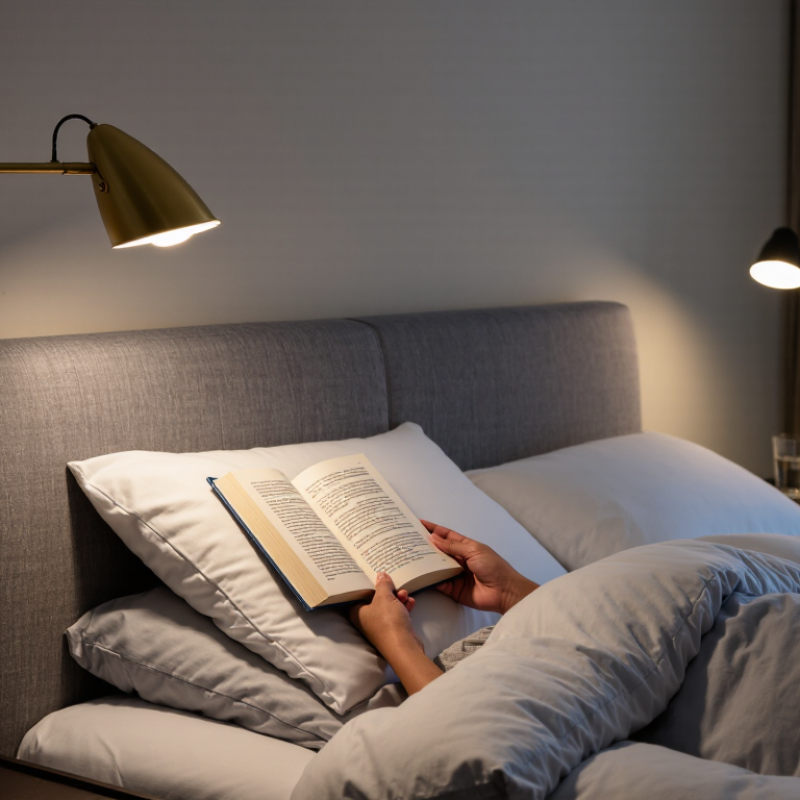
Assess the Ideal Height for Bedside Wall Lamps
How to Place Wall Lamps for the Best Bedside Reading?
The ideal height for bedside wall lamps depends on your mattress, headboard, and reading posture. A useful starting point is placing the lamp’s lower edge 20 to 24 inches above the mattress surface. This keeps the light near shoulder level while reducing harsh shadows across the page. The lamp should also sit about 6 to 12 inches beside the bed, measured from the mattress edge.
Sit upright in your usual reading position before marking the wall. Your eyes should align comfortably with the lower half of the shade, not stare directly into the bulb. For many adults, the lamp center falls around 55 to 65 inches above the floor. However, this range is not a rule. A thick mattress or tall headboard can change the best position. Measure twice.
Adjustability matters.
A swing arm or tilting shade can direct light onto a book without disturbing a sleeping partner. Keep the switch within easy reach, ideally near shoulder height. Avoid placing the light so high that it illuminates the ceiling more than the page. Avoid placing it too low, too. The wall and pillow may absorb much of the useful light.
I once underestimated how much a soft mattress compresses overnight. The lamp looked correctly placed during installation, yet felt high after use. A small adjustment solved it. Real comfort is discovered in bed, not only with a tape measure.
Choose the Best Horizontal Position Beside the Bed
A wall lamp works best when its horizontal position supports your reading posture, not just the room’s symmetry. Place the lamp roughly 20–30 centimetres outside the mattress edge. Keep it slightly forward of the pillow, near the reader’s shoulder line. This position directs light across the page and reduces shadows from your head and hand. With two beds, measure from each mattress separately. Do not rely on the wall’s centreline.
The Illuminating Engineering Society’s Lighting Handbook commonly places reading tasks near 300–500 lux, depending on age, print size, and visual demand. EN 12464-1:2021 lists 500 lux for many detailed reading environments. These figures do not mean your bedroom should feel like an office. A dimmable fixture is more practical. Aim the beam toward the book, not directly toward your eyes. A frosted diffuser can also soften glare. Small adjustment matters.
Sit in bed before drilling. Hold a book at your usual distance, then move a temporary lamp along the wall. Check whether your shoulder blocks the beam. I often find that the first position looks too far outward. That mistake is easy to make. A 5–10 centimetre shift can improve comfort, especially with deep mattresses or adjustable headboards. Leave enough clearance for curtains, switches, and bedside movement. The best horizontal position is personal, and a floor plan cannot fully predict it.
How to Place Wall Lamps for the Best Bedside Reading? - Choose the Best Horizontal Position Beside the Bed
| Bed Size |
Standard Mattress Width |
Recommended Lamp Centerline |
Horizontal Reference Point |
Typical Nightstand Width |
Reading Position Benefit |
Installation Check |
| Twin / Single |
38 in (97 cm) |
6–10 in (15–25 cm) outside the mattress edge |
Place the lamp center approximately 6–10 in beyond the side of the mattress, aligned with the reader’s upper torso. |
18–24 in (46–61 cm) |
Directs light toward one reader without placing the fixture too far from the pillow area. |
Confirm that the lamp does not project over the walking path or interfere with curtains and wall trim. |
| Full / Double |
54 in (137 cm) |
8–12 in (20–30 cm) outside the mattress edge |
Center the lamp beside the sleeper’s shoulder zone rather than at the exact midpoint of the bed. |
20–26 in (51–66 cm) |
Provides a more focused reading beam while leaving the central sleeping area visually uncluttered. |
Measure from the finished mattress edge, not from the bed frame, because frames can vary in width. |
| Queen |
60 in (152 cm) |
8–12 in (20–30 cm) outside the mattress edge |
Install one lamp on each side, with each centerline positioned beside the corresponding sleeper. |
22–28 in (56–71 cm) |
Two independently positioned lamps reduce shadows and allow each reader to control light separately. |
Keep both lamp centerlines symmetrical unless the room layout requires different nightstand positions. |
| King |
76 in (193 cm) |
10–14 in (25–36 cm) outside the mattress edge |
Position each lamp beside the outer shoulder area instead of using the bed’s overall center as the reference. |
24–30 in (61–76 cm) |
Maintains comfortable light coverage across the wider bed while keeping each beam close to its reader. |
Check that the lamp is within easy reach from a seated position and remains clear of tall headboards. |
| California King |
72 in (183 cm) |
10–14 in (25–36 cm) outside the mattress edge |
Use the side mattress edges as the primary horizontal reference because the bed is longer than a standard king. |
24–30 in (61–76 cm) |
Places the reading light near each sleeper while preserving usable space along the longer bedside wall. |
Verify the lamp position against the headboard length and the location of electrical wiring before drilling. |
| Adjustable or Split Bed |
Varies by configuration |
Align with each sleeper’s shoulder area; normally 6–14 in (15–36 cm) outside the mattress edge |
Base the position on the raised reading posture, not only on the mattress when it is completely flat. |
18–30 in (46–76 cm) |
Keeps the light aimed at the reading area when the head section is elevated. |
Test the full range of bed movement to ensure the lamp, cord, and headboard do not collide. |
Set the Correct Reading Angle and Light Direction
How to Place Wall Lamps for the Best Bedside Reading?
Set the Correct Reading Angle and Light Direction
Good bedside reading starts with the lamp’s position, not its appearance. Mount the light about 50 to 65 centimeters above the mattress. This height usually keeps the beam near your book without shining directly into your eyes. When seated, the lamp should sit slightly behind your shoulder. That position reduces shadows across the page.
Aim the light downward at roughly a 30-degree angle. The beam should touch the center of the book, not the reader’s face. An adjustable shade or joint makes this easier, especially when reading in different positions. For a right-handed reader, placing the lamp on the left can reduce hand shadows. Left-handed readers may prefer the opposite side. Keep the light direction consistent with your usual posture.
Test it before fixing the lamp permanently. Sit in bed with an actual book, rather than judging from the floor. Check the page from several angles. A bright spot on the wall may indicate wasted light, while dark lettering can signal poor coverage. I once installed a lamp too far forward, and my head blocked the beam. It looked correct during installation. It was not comfortable at night. A warmer, moderate light often feels easier on tired eyes, but personal comfort still matters. Bed frames, pillows, and reading habits can change the ideal placement.
How to Place Wall Lamps for the Best Bedside Reading?
Aim the lamp downward and across the book rather than directly toward the reader’s eyes. The chart shows practical illuminance targets for different beam directions, based on the commonly recommended 300–500 lux range for reading tasks.
Check Safety, Comfort, and Symmetry Before Final Installation
How to Place Wall Lamps for the Best Bedside Reading?
Safety should guide the first measurement, not decoration. Keep the lamp away from loose bedding, curtains, and direct contact with pillows. A licensed electrician should inspect wiring, wall support, and local installation requirements. This matters especially for heavy fixtures or hardwired lamps. Choose bulbs that produce limited heat, and keep the switch reachable from the bed. Test it at night. Bright glare from a bare bulb can make reading uncomfortable and may disturb a sleeping partner.
Comfort depends on your actual reading posture. Sit against the headboard and mark the height of your eyes. The lamp should usually sit slightly above eye level, directing light onto the page without shining into your face. Adjustable shades can help, but their joints may loosen over time. Check the beam while holding a book, not while standing in the center of the room. A small change of angle can remove a sharp shadow from your writing hand.
Symmetry makes the bedroom feel intentional. Measure from the mattress edges, headboard, and floor before drilling. Measure twice. Matching heights are useful, but identical spacing may not suit uneven walls or different bed positions. I once installed two lamps perfectly level, then noticed one looked higher beside a sloping ceiling. That mistake changed my view: visual balance sometimes needs a small adjustment, not blind precision. Mark holes with temporary tape and live with the layout for one evening before final installation.
Conclusion
Where to place wall lamps for the best bedside reading experience? Start by positioning each lamp at a height that places the light source slightly above eye level when you are sitting in bed. This helps illuminate the page without shining directly into your eyes. Horizontally, install the lamp close enough to the bed for convenient use, while keeping it clear of pillows, headboards, and moving arms. A flexible fixture or adjustable shade can direct light downward and toward the reading area, reducing glare and unwanted shadows.
Choose a brightness that makes text easy to read without disturbing your partner, and consider a warm-to-neutral color temperature for a comfortable, focused atmosphere. Before final installation, test the lamp from your usual reading position, checking for reflections, heat, loose cables, and easy access to the switch. Matching the height and placement on both sides of the bed creates a balanced appearance, while personal adjustments ensure the lighting remains comfortable and practical for nighttime reading.

 Trandic Light